Introduction
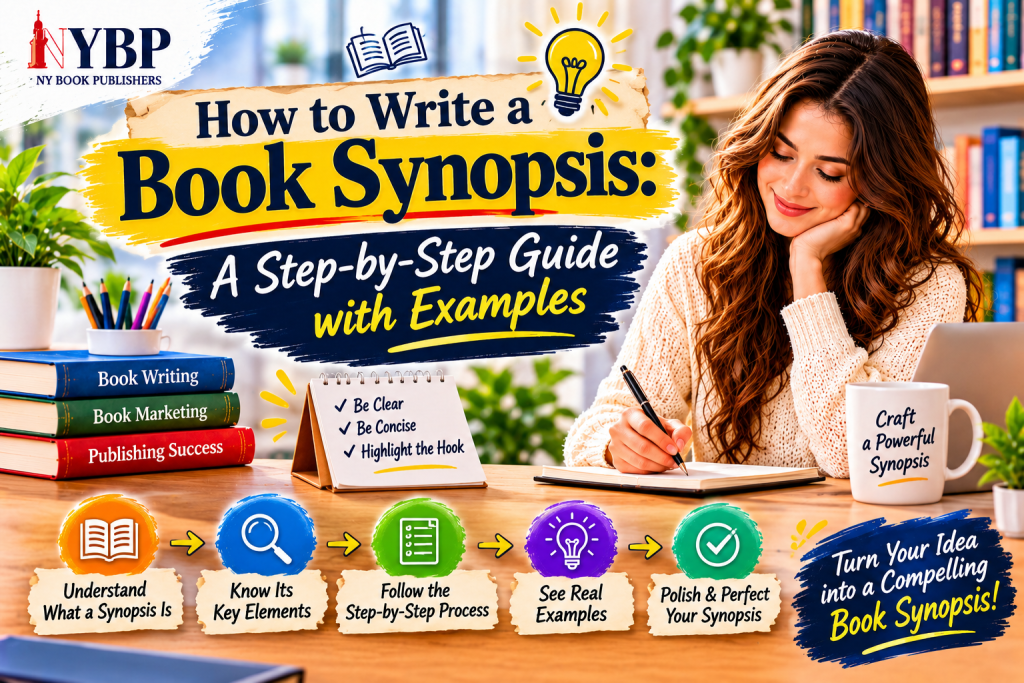
A synopsis is a short summary of your whole book, ending included, that you send to agents and publishers to show how your story or argument works from start to finish. If you’ve just finished a manuscript, learning how to write a synopsis for a book is probably the next hurdle, and it’s one that trips up even experienced writers. Summing up eighty thousand words in a page or two feels almost unfair. The good news is that a synopsis follows a fairly predictable shape. In this guide, we’ll cover what it includes, how long it should be, how to format it, and how to adjust it for novels, picture books, poetry, self-help books, and proposals. If you’d like help shaping a manuscript before you submit it, book writing services for authors can guide you from rough draft to polished pages.
What Is a Book Synopsis?
A book synopsis is a condensed, present-tense retelling of your entire book. It covers the main plot points, the key characters, and how everything resolves. Agents and editors use it to check that your story holds together, that the pacing works, and that the ending delivers on the promise of the opening.
Many writers confuse it with other short pieces, so it helps to compare them.
| Document | Purpose | Reveals the ending? |
| Synopsis | Shows how the whole book works | Yes |
| Blurb | Sells the book to readers | No |
| Query letter | Pitches you and your book to an agent | No |
| Book summary | Gives a general overview of what a book covers | Usually yes |
If you’d like to write the reader-facing version, our guide on how to write a book blurb covers it in detail.
Should a Book Synopsis Reveal the Ending?
Yes. This surprises many writers, because we’re taught to protect spoilers. But a synopsis isn’t marketing copy. It’s a professional document, and an agent needs to know whether your plot actually pays off. A synopsis that stops before the ending looks like you’re hiding something, or worse, that you haven’t figured it out. So, tell the reader how it ends, and do it plainly.
How Long Should a Book Synopsis Be?
Length varies, so always follow the guidelines of whomever you’re submitting to. As a general rule, though, these ranges work well:
- One page (about 400 to 500 words, single-spaced) is the most common request.
- Two pages (about 800 to 1,000 words) is also widely requested.
- A short synopsis of a paragraph or two (around 150 to 250 words) is sometimes asked for in addition.
Because requests differ, it’s smart to prepare a short, one-page, and two-page version once your manuscript is finished. Then you can send whichever one an agent asks for.
What Should Be Included in a Book Synopsis?
A strong synopsis keeps its focus tight. Include the main character and what they want, the central conflict, the major turning points, the emotional or intellectual shift in the story, and the resolution. Leave out minor characters, side plots that don’t affect the main thread, and long descriptions of setting. A helpful test is to ask of every sentence: does the reader need this to understand how the story moves from beginning to end? If not, cut it.
How to Write a Synopsis for a Book: Step by Step
Here’s a simple process that works for most fiction and narrative nonfiction.
- Start with one sentence
Write the core of your book in a single line: who wants what, what stands in the way, and what happens. This becomes your anchor. - List your major plot points.
Jot down the opening situation, the event that sets things in motion, the main complications, the midpoint shift, the low point, the climax, and the resolution. - Write a rough draft in present tense.
Use third person, even if your book is in first person, and keep the language clear and direct. - Show cause and effect.
Don’t just list events. Explain why one thing leads to the next, because that’s what proves the story holds together. - Name only the essential characters.
Introduce the main ones with a quick descriptor the first time, and leave out the rest. - Include the emotional arc.
Agents want to see how your character changes, not just what happens to them. - Trim and polish.
Cut until it fits the requested length, then read it aloud for flow.
This is the same shape you’d follow for how to write a book synopsis for a literary agent, since agents are the most common readers of this document.
Synopsis Format: How to Lay It Out
Format matters because it signals professionalism. Most agents and publishers expect a simple, clean document.
- Put the title of your book and your name at the top.
- Use a standard font such as Times New Roman or Arial, around 11 or 12 points.
- Keep it single-spaced unless the guidelines say otherwise.
- Write in present tense and third person.
- Use short paragraphs with clear breaks.
- Capitalize character names the first time they appear, if the agent prefers that style, though many no longer require it.
When in doubt, follow the submission guidelines to the letter. If an agent asks you to paste the synopsis into an email rather than attach it, do exactly that.
How to Write a Book Synopsis for Querying
When you’re querying agents, the synopsis usually travels alongside your query letter and a few sample pages. The query letter pitches your book, while the synopsis proves the structure. So the two should feel consistent, but they shouldn’t repeat each other word for word. Keep your synopsis factual and smooth, and save the voice-driven hook for the query. If you’re not sure how the query itself should look, you’ll want to learn that separately, since agents read both together. And remember that a book synopsis for a publisher or agent is evaluated on clarity first, so don’t try to be clever at the expense of being understood.
How to Write a Synopsis for a Novel
For a novel, build your synopsis around the plot spine. Start with your protagonist’s ordinary world, move into the event that disrupts it, and follow the major turning points to the climax and resolution.
Here’s a short example, written for a fictional cozy mystery:
Nora Finch, a burned-out pastry cook, inherits her late aunt’s failing bakery in a small coastal town. While cleaning the oven, she finds a coded recipe card that her aunt hid before she died. Nora has one month to save the shop from the bank, and she begins to suspect that the card points to a secret someone in town will do anything to protect.
As Nora decodes the card, she befriends the baker next door and clashes with the town’s wealthy developer. A break-in at the bakery convinces her she’s being watched. At the midpoint, she learns her aunt was secretly gathering evidence of a land scheme that threatens to push out the town’s small businesses.
Nora’s investigation costs her a friendship when she wrongly suspects the baker. At her lowest point, the bank gives her a final warning, and the developer offers to buy the shop. Instead, Nora uses the last clue in the recipe to unlock her aunt’s hidden files, then exposes the scheme at a town meeting. The developer is arrested, the bank grants an extension, and Nora reconciles with the baker. She decides to stay and run the bakery, finally feeling at home.
This example is fictional and written only to show structure. Notice how every paragraph moves the story forward and ends with the resolution clearly stated.
How to Write a Synopsis for a Picture Book
Picture books are very short, so their synopses are too. Often a few sentences are enough, and many publishers want the full text rather than a long summary.
A picture book synopsis explains the story arc, the main character’s problem, how it’s solved, and the emotional takeaway. You might also briefly note the age range and any recurring structure, such as repetition or a refrain. And since publishers usually pair authors with illustrators, avoid describing the pictures unless the story truly depends on an image to make sense.
For example: “When Milo the mouse loses his favorite scarf, he searches the whole forest and meets three animals who each need something he can give. By the end, he has made friends and found that the scarf was in his own burrow all along, but the real treasure was the day he spent helping others.”
How to Write a Synopsis for a Poetry Book
A poetry collection doesn’t have a plot, so the synopsis works differently. Instead of summarizing events, you describe the book’s shape and themes.
Explain what the collection explores, how it’s organized (by section, time period, or emotional movement), and what the reader experiences moving through it. Mention the number of poems and any recurring images or forms. A short quote or two can help, as long as you stay within the length requested. And, as always, follow each publisher’s guidelines, since many poetry presses ask for sample poems and a brief description rather than a full synopsis.
How to Write a Synopsis for a Self-Help Book
For self-help and other prescriptive nonfiction, the synopsis explains your central idea, the problem it solves, and how the book unfolds. Think of it as walking an editor through the book’s argument chapter by chapter.
Cover who the book is for, the main promise, the method or framework you teach, and the way the chapters build. Then briefly describe the outcome a reader can expect. Because self-help is usually sold on a proposal rather than a finished manuscript, you’ll often pair this synopsis with a market analysis and sample chapters.
How to Write a Synopsis for a Book Proposal
In a nonfiction book proposal, the synopsis usually sits alongside an overview, a chapter outline, an author bio, and a market section. The chapter outline gives details, so the synopsis itself should stay brief and focus on the big picture: what the book is, why it matters, and how it flows from beginning to end.
Keep your tone confident but factual, and avoid repeating the exact wording you used in the overview. Each section of the proposal has its own job, and the synopsis’s job is to show that the whole book is thought through.
How to Write a Synopsis for a Book Chapter
Sometimes you need a synopsis of just one chapter, either for a proposal or for your own planning. Treat it as a mini version of the whole thing: state what happens or what’s argued, note the key turning point, and end with how the chapter sets up the next one. Two to five sentences per chapter is often plenty.
A Note on Book Review Synopses
If you’re writing a synopsis for a book review, the goal is different. Here you’re giving readers a brief overview of what the book is about, and you usually avoid spoilers, so the ending stays hidden. Keep it to a short paragraph before moving on to your opinion. This is a book summary for readers, not a submission document for agents.
Common Synopsis Mistakes to Avoid
A few mistakes appear again and again. Some writers include too many characters and subplots, which makes the document confusing. Others write in a flat, list-like way that loses the emotional heart of the story. Some skip the ending, while others get so lost in tiny details that they run out of room. It’s also easy to write in past tense or first person out of habit, so check for that. And finally, don’t forget to proofread, because a typo-filled synopsis undermines the confidence of an otherwise strong manuscript.
Key Takeaways
- A synopsis summarizes your entire book, including the ending, in present tense.
- Keep it to one or two pages unless the guidelines say otherwise.
- Focus on the main character, central conflict, turning points, and resolution.
- Show cause and effect so the story feels connected.
- Adjust your approach for novels, picture books, poetry, and nonfiction.
- Follow each agent’s or publisher’s guidelines exactly.
Close
Knowing how to write a synopsis for a book gives you a tool you’ll use again and again, from your first query to your next proposal. Start with a single sentence, build your plot points, show how each event leads to the next, and trim until every line earns its place. If you’d like help polishing your manuscript or your submission materials, our team of book writing experts is ready to support you every step of the way.
Frequently Asked Questions
What is a book synopsis?
A book synopsis is a short summary of your entire book, including the ending, written in present tense. Agents and publishers use it to see how your story or argument works from start to finish.
How do you write a synopsis for a book?
Start with a one-sentence summary, list your major plot points, then draft in present tense and third person. Show cause and effect, name only the essential characters, and trim to the requested length.
How long should a book synopsis be?
Usually one to two pages, or about 400 to 1,000 words. Some agents ask for a short version of 150 to 250 words, so always follow their guidelines.
What should be included in a book synopsis?
Include the main character and goal, the central conflict, major turning points, the emotional arc, and the ending. Leave out minor characters and unnecessary subplots.
What is the difference between a book synopsis and a book summary?
A synopsis is a professional submission document that reveals the whole plot, ending included. A summary is a general overview of a book and may leave out the ending, depending on its purpose.
Should a book synopsis reveal the ending?
Yes. Agents and publishers need to see that your story resolves in a satisfying way, so a synopsis should state the ending clearly.
How do you write a synopsis for a novel?
Follow the plot spine from the opening situation through the key turning points, the climax, and the resolution, using present tense and showing how each event causes the next.
What is the correct format for a book synopsis?
Use your title and name at the top, a clean 11 or 12 point font, single spacing, short paragraphs, and present tense in third person. Always follow each submission’s specific guidelines.