Overview
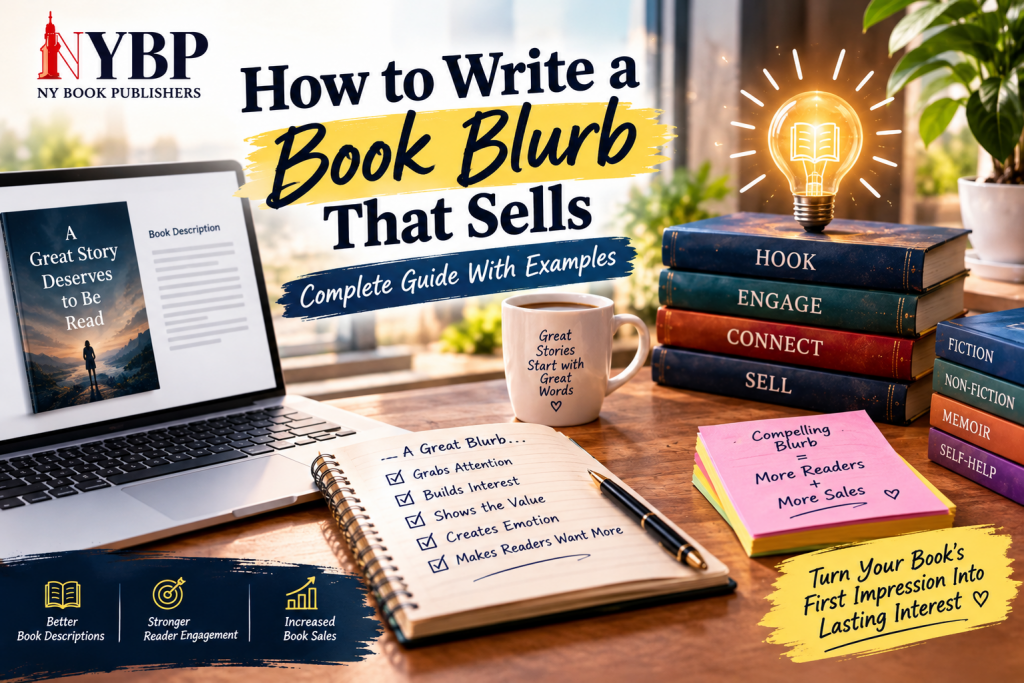
Your book blurb is doing one of the most important jobs in publishing. Before a reader commits to buying your book, before they read the first chapter, before they even look at the author bio, they read the blurb. And in about thirty seconds, they decide whether this book is for them. Knowing how to write a book blurb that actually converts browsers into buyers is a skill that every author needs, whether you are writing a debut novel, a nonfiction guide, a children’s picture book, or a poetry collection. This guide walks you through what a book blurb is, how to structure it, what makes one work, and what kills it, with examples and practical steps you can apply to your own book today. If you need help at the writing stage before you ever get to the blurb, book writing services are available to help you develop your manuscript from concept to finished draft.
What Is a Book Blurb?
A book blurb is the short promotional text that appears on the back cover of a printed book or in the book description section of an online listing. Its sole purpose is to make the reader want to buy and read the book.
A blurb is not a summary. It does not tell the reader everything that happens. It does not give away the ending. It is a carefully crafted piece of persuasive writing that creates curiosity, establishes the stakes, introduces the main character or central argument, and ends with a hook that makes the reader feel they must know what happens next.
Where does a book blurb appear? In print, it sits on the back cover and sometimes on the inside front flap of a hardcover. Online, it appears as the product description on Amazon, on Goodreads, on Apple Books, and on every other retail and library platform where your book is listed. It is the text that shows up in search results, on social media previews, and in email campaigns. Getting it right has direct commercial consequences.

How to Write a Book Blurb: The Core Structure
Most effective book blurbs for fiction follow a three-part structure. Once you understand this structure, you will recognize it in nearly every back cover you pick up.
Part 1: Hook
The opening line or two of a book blurb needs to do the same job as the opening line of the book itself: create immediate interest. It should establish tone, genre, and the central promise of the story before the reader has finished the first sentence.
A weak hook describes the book. A strong hook makes the reader feel something or want to know something they did not know a moment ago.
Weak: “This is a story about a woman who discovers a secret in her late grandmother’s house.”
Stronger: “Her grandmother left her a house. She just did not know the house had a secret of its own.”
The second version creates tension, implies mystery, and raises a question the reader wants answered.
Part 2: Setup
The setup introduces the protagonist and the central conflict in specific, vivid terms. It establishes the world of the story, the stakes, and the main problem or question the narrative will revolve around.
This section should be one to three paragraphs of two to four sentences each. Keep it tight. Every sentence should earn its place by either establishing character, conflict, or stakes.
Avoid vague language. “A woman must face her past” is generic and forgettable. “A forensic accountant discovers that the fraud she has been hired to investigate leads directly to her missing sister” is specific, propulsive, and full of forward momentum.
Part 3: The Closing Hook
The final sentence or two of a fiction blurb creates the question the reader must answer by reading the book. It raises the ultimate stakes without resolving them.
“Some secrets are buried for a reason. Some should stay that way.”
“She has one chance to save them both. And she is not sure she can trust herself.”
The closing hook does not tell the reader what happens. It makes them feel that they need to find out.
How to Write a Good Book Blurb: Fiction vs Nonfiction
The structure and purpose of a book blurb differ significantly between fiction and nonfiction. Understanding this difference is essential before you start writing.
Fiction Blurb
A fiction blurb creates emotional and narrative tension. It focuses on character and conflict, uses present tense and active voice, and holds back the resolution to create urgency. The reader should finish the blurb feeling hooked into the story.
Key elements of a fiction blurb:
- Protagonist introduced in one specific, vivid sentence
- Central conflict established with clear stakes
- Emotional core of the story implied or stated
- Closing hook that raises the unanswered question
Nonfiction Blurb
A nonfiction book blurb sells a promise: this book will teach you something, solve a problem, or change how you think about something. It focuses on the reader’s benefit rather than narrative tension.
How to write a blurb for a nonfiction book involves answering three questions in the blurb itself: what is the core argument or subject, why should the reader care, and what will they gain from reading this book?
Key elements of a nonfiction blurb:
- A clear statement of the book’s central argument or purpose
- The problem or gap the book addresses
- What the reader will learn or gain
- The author’s credibility in one sentence if it is relevant and genuine
Example structure for a nonfiction blurb:
“Most people are not bad at managing money. They are bad at managing the habits that lead to financial decisions. In [Book Title], [Author Name] shows how the unconscious patterns we develop in our twenties shape every major financial choice we make for the rest of our lives, and exactly how to rewire them.”
This blurb identifies a relatable problem, frames the book’s central argument, and promises a specific benefit.
How to Write a Book Blurb: A Step-by-Step Process
Here is a practical process for writing your own book blurb from scratch.
Step 1: Write your one-sentence premise
Before you write the blurb, write a single sentence that captures the core of your book. Who is the protagonist? What do they want? What is standing in their way? This sentence becomes the backbone of everything else.
Step 2: Identify the central conflict and the stakes
What happens if the protagonist fails? What is genuinely at risk? Stakes create urgency and urgency sells books. If the stakes are low or vague, the blurb will feel flat.
Step 3: Find the emotional core
What does the reader feel when they read your book? Fear, hope, heartbreak, curiosity, wonder? Your blurb should create a version of that feeling. Readers buy the emotional experience a book promises, not just the plot.
Step 4: Write a rough draft without editing
Write the entire blurb in one sitting without stopping to revise. Get the core elements down: hook, setup, stakes, closing hook.
Step 5: Cut ruthlessly
A book blurb should be approximately 150 to 250 words for most adult fiction and nonfiction. Read every sentence and ask: does this create interest or does it just describe? Cut description, cut backstory, cut any sentence that does not move the reader closer to wanting to read the book.
Step 6: Read it as a reader, not as the author
The biggest challenge in writing your own blurb is that you already know the whole story. You will naturally want to include context and details that seem essential to you but are actually just clutter to someone coming to the book fresh. Read it as someone who knows nothing about your book and ask: does this make me want to find out what happens?
Step 7: Test it
Share your blurb with two or three people who are in your target readership and ask them whether they would pick up the book based on the blurb alone. Their answer tells you more than any writing guide can.
How to Write a Blurb for Someone Else’s Book
Writing a blurb for someone else’s book, either as a ghostwriter, a publisher, or a copywriter, follows the same structural principles but requires additional preparation. You need to understand the book well enough to write about it as if you had written it yourself. That means reading it thoroughly, identifying the protagonist’s core motivation and central conflict, understanding the genre’s conventions and reader expectations, and grasping the emotional experience the book delivers.
The most important thing when writing a blurb for someone else is to write in the book’s tone rather than your own. A dark psychological thriller and a cozy contemporary romance require entirely different blurb voices. Matching that voice is what separates a blurb that sells the right book to the right reader from one that creates false expectations.
How to Write a Blurb for a Children’s Book
Writing a blurb for a children’s book presents a specific challenge because children’s books have two distinct audiences: the child who will read or be read to, and the adult who will purchase the book.
A children’s book blurb needs to appeal to both. It should be warm, accessible, and speak directly to the child’s world at the level appropriate to the age group. Simultaneously, it should give the purchasing adult enough information about the book’s tone, theme, and content to decide whether it is appropriate and appealing for the child they are buying for.
For picture books (ages three to six), the blurb is typically very short, often just two or three sentences, because the book itself is very short. It should capture the central idea of the story, the emotional tone, and ideally the character’s name and central dilemma.
Example structure for a picture book blurb:
“When Max the rabbit cannot find his favourite hat, he searches everywhere, from under the bed to the top of the tallest tree. But sometimes the thing you are looking for is closer than you think.”
For middle grade and young adult, the blurb follows a structure closer to adult fiction but with language and concerns appropriate to the age group.
How to Write a Book Blurb for Poetry
A poetry collection blurb works differently from fiction or narrative nonfiction because there is no central character or unfolding plot to summarize. A poetry blurb establishes the collection’s emotional territory, its central themes and concerns, and the distinctive quality of the poet’s voice. It should evoke the experience of reading the collection rather than describing individual poems.
Think of it as a blurb for a feeling rather than a story. What emotion does this collection inhabit? What questions does it return to? What kind of reader will find something true in it?
Common Mistakes That Weaken a Book Blurb
Even strong writers make these mistakes when writing their own blurb. Knowing them in advance helps you avoid them.
Starting with backstory: The blurb should open with what is happening now, not the events that led to it. Backstory kills momentum before it has started.
Being vague about the conflict: Phrases like “must face the consequences of her choices” or “discovers the truth about himself” are nearly meaningless without specifics. What consequences? What truth?
Giving away too much: The blurb should raise the question, not answer it. If the reader knows how the story resolves, there is no reason to read it.
Overwriting: Long sentences, purple prose, and excessive adjectives all slow the blurb down. Simple, punchy, and direct is almost always more effective.
Matching the book’s tone incorrectly: A literary fiction blurb written in the breathless style of a thriller, or a thriller blurb written with literary restraint, creates a mismatch between expectation and experience that leads to disappointed readers and negative reviews.
Book Blurb Template
Here is a simple book blurb template you can adapt for fiction:
[Hook: One to two sentences establishing tone and central tension]
[Setup: Character + goal + obstacle, two to three sentences]
[Stakes: What happens if they fail, one to two sentences]
[Closing hook: The unanswered question that drives the reader to open the book]
For nonfiction:
[Problem or gap statement: What challenge does your reader face?]
[What this book offers: The central argument, approach, or revelation]
[What the reader gains: Specific benefit or transformation]
[Author credibility line if genuinely relevant]
These are starting structures, not rigid formulas. Use them to get your draft on the page, then revise until it sounds like your book rather than a template.
Key Takeaways
- A book blurb is persuasive copy, not a summary. Its job is to sell, not to describe.
- Fiction blurbs should introduce the protagonist and conflict, establish stakes, and end with an unanswered question.
- Nonfiction blurbs should identify the reader’s problem, present the book’s central argument, and promise a specific benefit.
- Children’s book blurbs address both the child reader and the adult purchaser.
- Keep your blurb between 150 and 250 words for most book types.
- Write it, cut it aggressively, and test it on readers in your target audience.
- The single most common mistake is giving away too much. The blurb raises the question. The book answers it.
Let NY Book Publishers Help You Write and Publish Your Book
A great blurb starts with a great book. If you are still working on your manuscript and want professional support from the earliest stages, ghost book writing services at NY Book Publishers are designed to help you develop your idea into a polished, publishable manuscript. You can also explore how to write a book and get it published for a complete step-by-step guide to the publishing process.
Frequently Asked Questions
How do you write a book blurb for beginners?
Start by writing one sentence that captures the core of your book: who the protagonist is, what they want, and what stands in their way. Then expand that into a short paragraph establishing the conflict and stakes. Add an opening hook that creates immediate tension and close with an unanswered question that makes the reader want to open the book. Aim for 150 to 250 words. Cut anything that describes rather than creates interest.
What should be included in a book blurb?
A fiction blurb should include an opening hook, the protagonist and their central goal, the main conflict and what is at stake, and a closing line that raises the unanswered question. A nonfiction blurb should include the central problem the book addresses, the author’s approach or argument, and the benefit the reader will gain. Both types should avoid revealing the ending or resolution.
How long should a book blurb be?
Most book blurbs are between 150 and 250 words. Children’s picture book blurbs are shorter, often 50 to 100 words. Back cover copy for trade paperbacks and hardcovers typically runs 150 to 200 words. Online product descriptions on platforms like Amazon allow more space but readers rarely read more than 250 words before deciding whether to buy, so brevity and impact matter more than length.
What is the difference between a book blurb and a book synopsis?
A book blurb is promotional copy designed to sell the book to readers. It creates curiosity and withholds the ending. A synopsis is a complete summary of the entire book including the ending, written for agents and publishers to evaluate the narrative or argument. The blurb appears on the back cover and in retail listings. The synopsis is a submission document sent to publishing professionals. They serve entirely different purposes and are written in entirely different ways.
How do you write a book blurb without spoilers?
Focus on the setup rather than the resolution. Introduce the protagonist and their goal, establish the central conflict and the stakes, and then stop before you reveal how the conflict resolves. Ask yourself: what is the question my book answers? Your blurb should ask that question as compellingly as possible without answering it. The ending belongs in the synopsis, not the blurb.
How do you write a book blurb that attracts readers?
Use specific, vivid language rather than vague generalisations. Name the central conflict precisely. Give the protagonist one clear defining characteristic rather than a general description. Make the stakes feel genuinely significant. Write in the same emotional register as the book itself so readers know what experience they are buying. And end with a line that creates urgency, the unanswered question the reader must find the answer to.
What is the difference between an ARC and a beta reader?
An ARC (Advance Review Copy) is a version of the finished or near-finished book sent to reviewers, bloggers, and media contacts before the official publication date to generate early reviews and publicity. A beta reader reads a draft manuscript before final editing is complete and provides feedback on the reading experience: pacing, character, clarity, and engagement. ARCs are for external promotion. Beta readers are part of the development process.
Where does a book blurb appear?
A book blurb appears on the back cover of a printed paperback, on the inside front flap of a hardcover, in the product description section of online retailers like Amazon, Waterstones, and Apple Books, on Goodreads, in library catalogues, in publisher catalogues, and in any marketing or promotional material created around the book. It is the most widely read piece of text associated with your book outside of the book itself.