
Table Of Contents
- Intro
- What Does “Don’t Judge a Book by Its Cover” Mean?
- Where Did This Phrase Come From?
- Don’t Judge a Book by Its Cover: Real-Life Examples
- Never Judge a Book by Its Cover — Life Lessons That Actually Matter
- How to Say “Don’t Judge a Book by Its Cover” in Different Ways
- What Makes a Great Book Cover?
- Book Cover Ideas That Work
- What Is a Book Cover Generator?
- How to Make a Book Cover (The Right Way)
- The Back Cover of a Book: Don’t Overlook It
- To Conclude…
- Frequently Asked Questions
Intro
We’ve all heard it. A teacher said it. A parent repeated it. Maybe you’ve said it yourself. “Don’t judge a book by its cover.” It’s one of those phrases that sticks with you because deep down, you know it’s true. The saying is simple. The lesson behind it is anything but. In this article, we’re going to unpack what this phrase really means, where it came from, how it shows up in everyday life, and yes, what it actually has to do with real book covers. Whether you’re here for the life lesson or the book cover design insight, you’ll find both.

What Does “Don’t Judge a Book by Its Cover” Mean?
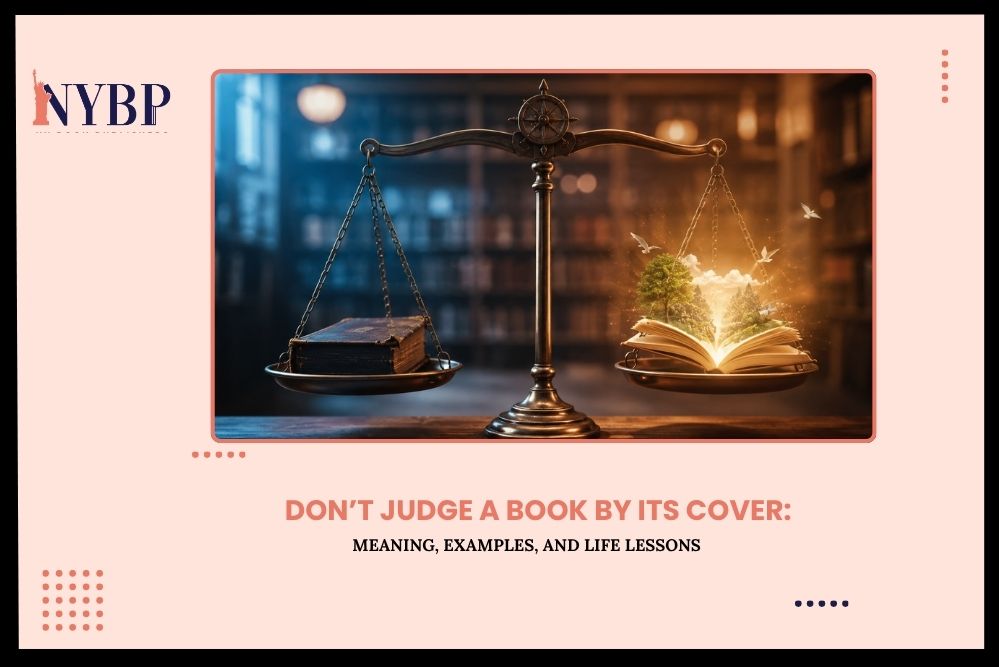
Let’s start with the basics. The “don’t judge a book by its cover” meaning is this: don’t form an opinion about someone or something based solely on how they look on the outside. The phrase is a metaphor. A book’s cover might be dull, worn, or plain. Inside, it could be a masterpiece. The same goes for people, places, and situations. What you see first isn’t always what something truly is.
The idiom refers to not judging the worth or value of something or someone by their outward appearance alone. It’s a reminder to look deeper before deciding. Here’s a real-life example. The Alchemist by Paulo Coelho was rejected by its first publisher. The initial print run was tiny. Nobody expected much. Today, it’s one of the best-selling books in history — translated into over 80 languages. If readers had judged it by its early presentation, millions of people would have missed a life-changing story. That’s exactly the point. First impressions sometimes lie.
Where Did This Phrase Come From?
Phrases like this don’t appear out of nowhere. This one has a surprisingly old paper trail. In George Eliot’s The Mill on the Floss (1860), a character uses the phrase while discussing a beautifully bound copy of Daniel Defoe’s The History of the Devil. It was one of the earliest written uses of the concept.
The phrase was further popularized when it appeared in the 1946 murder mystery Murder in the Glass Room by Lester Fuller and Edwin Rolfe, with the line: “You can never tell a book by its cover.” Since then, it has become one of the most widely recognized idioms in English. It shows up in classrooms, workplaces, self-help books, and everyday conversation, and it hasn’t lost its edge. If anything, it’s more relevant now than ever.
Don’t Judge a Book by Its Cover: Real-Life Examples
Knowing the phrase is one thing. Seeing it in action is another. Here are some real examples — in life, in literature, and in business.
In People
Think about someone you misjudged at first. Maybe a quiet coworker who turned out to be the funniest person in the office. Maybe a neighbor who seemed unfriendly but was just shy. We tend to make quick decisions about everything in today’s fast-paced world. The problem with rushing to judgment, especially about people, is that we may make an entirely wrong assessment without all the information. It happens to all of us, and it costs us friendships, opportunities, and connections.
In Books
Harry Potter and the Philosopher’s Stone by J.K. Rowling was rejected by 12 publishers. Twelve people looked at that manuscript and decided it wasn’t worth it. One said yes. The rest of that story, you already know. Gone Girl by Gillian Flynn has a simple, almost forgettable cover. Nothing flashy. Just text and a blurred image. Inside? One of the most gripping thrillers written in the last two decades. Covers don’t always tell the truth about what’s inside.
In Business
A startup founder shows up to a meeting in jeans and a t-shirt. An investor almost walks out. That founder? He’s built a company worth $50 million. The investor who stayed? Made the best decision of his career. Judging a book by its cover in business leads to missed deals every time!
Never Judge a Book by Its Cover — Life Lessons That Actually Matter
This phrase isn’t just a nice saying. It carries lessons you can use every single day.
Lesson 1: Appearances Are Incomplete Information
When you look at someone and form an instant opinion, you’re working with maybe 1% of the full picture. Their history, their struggles, their talents, their character — none of that shows up in one glance. A person who looks disorganized might be the most creative thinker in the room. A neighborhood that looks rough might be full of the most resilient, hardworking people you’ll ever meet. Appearances give you a starting point — never a close.
Lesson 2: Your Bias Is Working Against You
We all have unconscious biases. They’re baked into us through years of experience, culture, and media. When you judge a book by its cover, your bias is doing the judging — not your reason. Recognizing that is the first step to changing it. The next time you form an instant judgment about someone, pause. Ask yourself: what do I actually know here? Usually, the answer is very little.
Lesson 3: People Deserve the Chance to Show You Who They Are
If we make a point to treat people equally, regardless of what we may experience in our initial introduction, we may come to find our judgments couldn’t have been more wrong. Give people time. Give them a conversation. Give them the benefit of the doubt. You’ll be surprised how often the story is completely different from what you imagined.
Lesson 4: How You Judge Others Reflects Back on You
When you judge quickly and harshly, it reveals something about your own thinking — not theirs. People who take time to understand before judging come across as wiser, kinder, and more mature. Leaders who practice this build stronger teams. Friends who practice this build deeper relationships.
How to Say “Don’t Judge a Book by Its Cover” in Different Ways
Sometimes you want to express the same idea without repeating the same phrase. Here are a few natural alternatives:
- “Never judge a book by its cover.”
- “Things aren’t always what they seem.”
- “Look before you leap to conclusions.”
- “Don’t judge the book by its cover — read a few pages first.”
- “Appearances can be deceiving.”
- “There’s more than meets the eye.”
All of these carry the same message. Use whichever fits the moment.
Now, Let’s Talk About Actual Book Covers
Here’s the twist. While the idiom tells us not to judge books by their covers, in the real world of publishing, book cover design matters enormously. Readers do judge books by their covers. Studies show that a buyer makes a decision within seconds of seeing a cover. So even though we shouldn’t judge, the reality is that most people do, which is why book cover design is a great skill.
What Makes a Great Book Cover?
A strong cover does three things fast:
- It tells you the genre immediately. A thriller looks different from a romance. A self-help book looks different from a sci-fi novel.
- It creates an emotional reaction. Curiosity. Intrigue. Warmth. Fear. The best covers make you feel something before you read a single word.
- It stands out in a crowded market. On Amazon, your cover is a thumbnail. It competes with thousands of others. It has to earn the click.
The Outsiders Book Cover
Take The Outsiders by S.E. Hinton. The various editions over the years have had very different covers — from simple, stark designs to illustrated versions showing the Greasers. Each cover sends a different message about what kind of book it is. The editions with darker, grittier covers tend to attract the right audience immediately — teenagers drawn to stories about identity, loyalty, and survival. That’s no accident. That’s intentional design.
Book Cover Ideas That Work
Your cover is the first thing a reader sees. Make it count. Here are five styles that consistently work.
-
Minimalist Design
One strong image. Clean fonts. Lots of white space. That’s it. The Road by Cormac McCarthy is a great example. The cover is sparse and quiet, just like the story. No clutter, no noise. Just a feeling that pulls you in. This style works well for literary fiction, memoirs, and psychological thrillers.
-
Bold Typography
Sometimes the title itself is the visual. No photo needed. No illustration. Just a powerful, well-chosen type. Gone Girl by Gillian Flynn does this perfectly. The font alone creates unease before you read a single word. This approach works great for thrillers, business books, and titles with short, punchy names.
-
Character-Driven Illustration
Readers connect with characters. Putting one front and center on your cover draws people in immediately. The Percy Jackson series by Rick Riordan is a perfect example. Each cover shows Percy in action, stakes high, world vivid. A young reader sees it and thinks, “I want to be in that story.” This style works best for YA, middle-grade fiction, and fantasy series.
-
Photographic Covers
A real photograph creates an instant emotional connection. It feels lived-in and true. Educated by Tara Westover uses a photographic cover that feels both personal and cinematic. Romance novels and memoirs lean heavily on this style and for good reason. It builds trust before the first page is turned.
-
Symbol-Based Design
One object. One idea. Everything the book stands for is captured in a single image. The Great Gatsby‘s iconic cover does exactly this. Those enormous eyes hovering over a glittering city say everything about illusion, longing, and the American Dream. No explanation needed. People still recognize that cover decades later. The best cover is one that’s true to your book, speaks to your reader, and stands out in your genre. Study what works in your category, then design with intention.
What Is a Book Cover Generator?
Not every author has a designer on speed dial. That’s where book cover generators and AI tools come in. A book cover generator is an online tool that lets you create a cover using pre-built templates. You choose your layout, add your title and author name, pick fonts and colors, and download the result.
Tools like Canva, Adobe Express, and Placeit are popular options. An AI book cover generator takes it a step further. Tools like Midjourney, DALL·E, and Ideogram let you describe a concept and generate original artwork for your cover. These tools have gotten remarkably good. In 2026, many indie authors use them to create draft covers that professional designers then refine. They’re a great starting point, especially if you’re early in the process and testing ideas.
How to Make a Book Cover (The Right Way)
Here’s a simple process that works:
- Study your genre: Look at the top 20 books in your category on Amazon. What do their covers have in common? Match those conventions.
- Choose your key image or concept: What single visual best represents your book?
- Pick your fonts carefully: Serif fonts feel classic. Sans-serif feels modern. Script fonts feel romantic or whimsical.
- Keep the back cover of a book clean: The back cover needs a strong blurb, author bio, barcode, and a short hook. Don’t overcrowd it.
- Test your cover: Show it to people in your target audience. Not your family. Your actual readers.
- Hire a professional if the stakes are high: For a book you’re serious about, a professional designer is worth every penny.
The Back Cover of a Book: Don’t Overlook It!
Most authors obsess over the front cover and forget the back; that’s a mistake! The back cover of a book is where a reader decides whether to buy. It’s your sales pitch in 150–200 words. It should:
- Open with a hook — a question, a bold statement, or a gripping scenario
- Describe what the book is about without giving everything away
- Include a short author bio that builds credibility
- End with something that creates urgency or curiosity
Think of it as the trailer for your book. Short, punchy, and impossible to ignore.
Don’t Stress and Get a Stunning Book Cover Designed by NY Book Publishers
Your story deserves a cover that turns heads. At NY Book Publishers, their team of professional designers creates covers that don’t just look good — they sell books. Every cover is built around your genre, your audience, and your story. No generic templates. No one-size-fits-all designs.
Just a custom, polished cover that makes readers stop scrolling and start clicking. Whether you need a minimalist design, bold typography, character illustration, or a striking photographic cover, NY Book Publishers handles it all. From the front cover to the back cover of a book, every detail is covered. Ready to make a great first impression? Let NY Book Publishers design a cover that your readers won’t forget.
To Conclude…
So, here’s where we land. “Don’t judge a book by its cover” is one of the most important lessons you can carry through life. It keeps you open. It keeps you fair. It keeps you from missing out on people, places, and experiences that could change everything. At the same time — if you’re an author — your cover matters. Readers will judge it. That’s just human nature. The good news? You can honor both truths. You can be a person who looks beyond the surface in life, and still invest in a cover that does justice to the story inside your book.
If you’re ready to create a cover that truly represents your work, NY Book Publishers’ book cover design services are built exactly for that. Their designers understand genre, reader psychology, and what makes a cover sell — so your book gets the outside it deserves, no matter how deep the inside goes. Don’t judge a book by its cover, and make sure nobody judges yours either.
Frequently Asked Questions
What does “don’t judge a book by its cover” mean?
It means you shouldn’t form an opinion about someone or something based only on how it looks on the outside. True value is often found beneath the surface.
Why is “don’t judge a book by its cover” an important life lesson?
It teaches empathy, open-mindedness, and fairness. Quick judgments based on appearances are often wrong — and they cause us to miss out on great people and opportunities.
Is “don’t judge a book by its cover” still relevant today?
More than ever. In a world driven by social media, quick scrolling, and instant opinions, the pressure to judge fast is intense. This phrase is a necessary reminder to slow down and look deeper.
How does this phrase apply to books?
Literally, it means a book’s physical cover doesn’t tell you how good the story is. Many great books have plain or unremarkable covers. Many forgettable books have beautiful ones.
What are the benefits of not judging a book by its cover?
You build richer relationships, make better decisions, develop stronger empathy, and stay open to opportunities others miss. In short, you see the world more clearly.