Opening
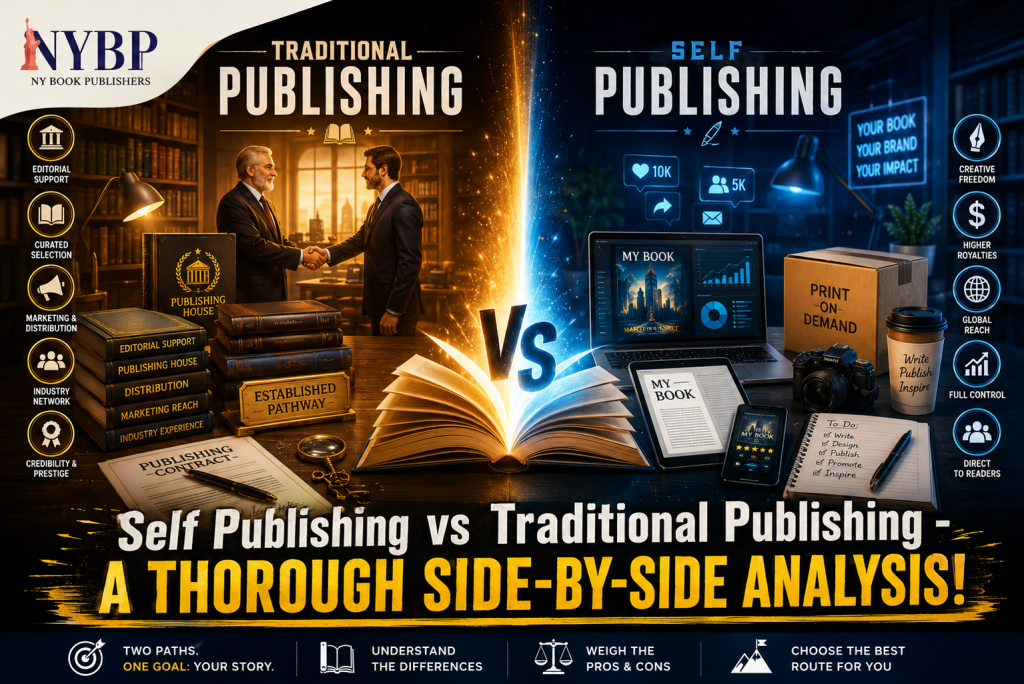
Every author eventually faces this decision. You have written your book, or you are close to finishing it, and now you need to figure out how it is actually going to reach readers. Self publishing vs traditional publishing is the choice that shapes everything that comes after, from how much money you make to how much control you keep to how long the whole process takes. There is no universally correct answer. The right path depends on your goals, your genre, your timeline, your budget, and honestly, your personality.
What this guide gives you is a completely honest, side-by-side analysis of both options so you can make the decision that is right for your specific situation rather than the one that sounds most impressive or most convenient. If you are already leaning toward independent publishing, self publishing platforms and self publishing book companies have made the process more professional and accessible than at any previous point in publishing history. If you are leaning traditional, this guide will help you understand exactly what you are signing up for there too.
Self Publishing vs Traditional Publishing: Understanding What Each Actually Means
Before comparing the two paths, it helps to be completely clear on what each one involves in practice.
What Is Self Publishing?
What is self publishing in concrete terms? Self publishing means you take full responsibility for every stage of bringing your book to market. You either do the work yourself or hire professionals to help with editing, cover design, interior formatting, and distribution. You upload the finished files to one or more publishing platforms and your book goes on sale. You set the price. You keep the majority of the royalties. You handle the marketing.
Self publishing a book gives you complete creative control and complete business responsibility simultaneously. There is no gatekeeper deciding whether your book is worthy of publication. There is also no publisher absorbing the costs, providing the infrastructure, or bringing their distribution relationships to the table.
The most popular self publishing platforms include Amazon KDP, IngramSpark, Draft2Digital, Smashwords, and Lulu. Each has different royalty structures, distribution reach, and technical requirements.

What Is Traditional Publishing?
Traditional publishing means your book is acquired by a publishing company that then handles editing, design, printing, and distribution using their own resources and infrastructure. In exchange, the publisher owns the publishing rights to your book for a defined period and pays you royalties on sales, typically after recouping an advance paid to you upfront.
To reach most traditional publishers, you need a literary agent. Agents represent authors to publishers, negotiate contracts, and take a commission of typically fifteen percent on domestic deals and twenty percent on foreign rights deals.
The traditional publishing process is significantly slower, more competitive, and less financially transparent than self publishing, but it comes with resources, distribution relationships, and credibility that self publishing cannot easily replicate.
The Core Comparison: Self Publishing vs Traditional Publishing Across Every Key Factor
Here is an honest, direct comparison across the dimensions that matter most to authors making this decision.
Speed to Publication
Self publishing wins this category decisively and it is not particularly close. A self published author who has a finished, edited, and designed manuscript can have their book available for purchase on Amazon within 24 to 72 hours of uploading. From decision to published book, the timeline can be measured in days.
Traditional publishing, by contrast, is one of the slowest processes in the creative industries. The query and submission process alone takes months to a year or more. Once you land an agent, the submission to publishers takes additional months. Once a publisher makes an offer and a contract is signed, the typical time from contract to publication is twelve to eighteen months, sometimes longer.
From the moment you finish your manuscript to the day your traditionally published book reaches readers, you are typically looking at two to four years. For some authors and some books, this timeline is manageable. For authors writing about timely topics or in fast-moving genres where trends shift quickly, it can be genuinely prohibitive.
Royalty Rates and Earnings Per Sale
This comparison is where the financial reality of the two paths becomes most starkly different.
Self published authors on Amazon KDP earn seventy percent royalties on eBooks priced between two dollars and ninety-nine cents and nine dollars and ninety-nine cents. For print-on-demand paperbacks, royalties are lower because printing costs are deducted, but authors still typically earn forty to sixty percent of the list price after production costs.
Traditionally published authors earn royalties that are substantially lower in percentage terms. Standard royalty rates for traditionally published books run roughly ten to fifteen percent of the list price for hardcovers, six to eight percent for paperbacks, and twenty-five percent of net receipts for eBooks. On a fifteen dollar paperback at seven percent royalties, the author earns just over one dollar per copy sold.
Here is a simplified comparison:
| Format | Self Publishing Royalty | Traditional Publishing Royalty |
| eBook | 70% of list price | 25% of net receipts |
| Paperback | 40–60% after print costs | 6–10% of list price |
| Hardcover | 40–55% after print costs | 10–15% of list price |
| Audiobook | 25–40% depending on platform | 10–15% typically |
The royalty difference is significant. Self published authors earn dramatically more per copy sold. However, traditionally published books often sell far more copies because of publisher marketing support, retail distribution, and the credibility that comes with a major imprint. Higher earnings per sale multiplied by lower sales volume can still produce less total income than lower earnings per sale multiplied by much higher volume.
Upfront Costs
This comparison reverses the financial advantage of self publishing when it comes to immediate out-of-pocket costs.
Traditional publishing costs the author nothing upfront. In fact, the author receives money in the form of an advance before the book is even published. The publisher absorbs all production costs including editing, cover design, formatting, printing, and distribution.
Self publishing requires the author to either do all of this work themselves, which costs time and often produces lower quality results, or to hire professionals, which costs real money.
Here is a realistic cost breakdown for a professionally self published book:
| Service | Typical Cost Range |
| Developmental editing | $1,500 to $5,000 |
| Copy editing | $500 to $2,000 |
| Proofreading | $300 to $1,000 |
| Cover design | $300 to $2,000 |
| Interior formatting | $200 to $800 |
| ISBN purchase | $125 to $295 |
| Marketing and launch | $500 to $5,000+ |
| Total range | $3,425 to $16,095+ |
Authors who skip professional editing and design to save money almost always produce books that read and look like they were created without professional support. This hurts sales, damages credibility, and often costs more in lost revenue than the saved production costs.
Creative Control
Self publishing wins this category completely and without nuance. When you self publish, every decision about your book is yours. The cover, the title, the price, the content, the release date, the marketing approach, and which platforms to sell on are all entirely under your control. If you want a purple cover with an unusual font, you can have one. If you want to price your book at ninety-nine cents for a promotional period, you can do that. If you want to release a second edition with updated content six months after the first, nothing stops you.
Traditional publishing involves handing significant creative control to your publisher. The publisher has final say over the cover design in most contracts. They may request or require content changes. They set the price. They control the distribution arrangements. They decide the publication date. Your input is sought and often valued, but it is not final.
Authors who have very strong opinions about specific elements of their book’s presentation, particularly the cover, sometimes find this aspect of traditional publishing genuinely frustrating.
Distribution and Retail Reach
Traditional publishing has a meaningful advantage here, though the gap has narrowed considerably in the digital age. A traditionally published book from a major publisher has relationships with physical bookstores across the country. Barnes and Noble, independent bookstores, airport bookshops, and library systems all order traditionally published books through established distribution channels. Your book will appear on physical shelves in ways that self published books typically do not.
Self published books distributed through IngramSpark can technically reach bookstores, but physical bookstores rarely order self published titles proactively. The lack of returnability, the absence of a publicist relationship, and the perception challenge of self publishing in retail contexts all limit physical retail presence for indie authors.
In the digital marketplace, the gap essentially disappears. A self published book on Amazon KDP reaches exactly the same pool of online shoppers as a traditionally published book. For many genres where most sales happen online, this makes the distribution advantage of traditional publishing less meaningful than it once was.
Marketing and Publicity
This is where many authors who choose traditional publishing discover an uncomfortable truth that their publishing contract does not fully prepare them for.
Traditional publishers do provide marketing and publicity support, but the level of support varies enormously and is generally concentrated on their highest-profile titles. A debut author with a modest advance is unlikely to receive significant marketing investment from their publisher beyond basic catalog listings and perhaps some social media promotion. The expectation that the author will do much of their own marketing is now standard across both traditional and self publishing.
Self published authors take on full marketing responsibility from day one and many approach this with genuine business sophistication. Email list building, Amazon advertising, social media marketing, podcast appearances, BookTok and BookStagram presence, and promotional platforms like BookBub are all tools that effective self published authors use consistently.
The difference is that traditionally published authors have a publicist they can work with, access to publisher relationships with major media outlets, and the credibility that often makes those media opportunities more accessible. Self published authors building media presence from scratch face a higher initial barrier even if their long-term results can be comparable.
Prestige and Credibility
This is the most subjective category in the comparison and the one that is changing most rapidly as self publishing matures.
Ten years ago, the stigma around self published books was significant and the quality gap was real. Many self published books were poorly edited, badly designed, and rushed to market without the professional development that traditionally published books received.
Today that gap has narrowed considerably. Professional self published authors who invest in editing, design, and production quality produce books that are indistinguishable in physical quality from traditionally published titles. The stigma has reduced, particularly in genres like romance, fantasy, and business books where self publishing is mainstream and commercially dominant.
That said, traditional publishing still carries prestige advantages in certain contexts. Academic and professional communities, mainstream media coverage, literary award eligibility, and library acquisition all still favor or exclusively consider traditionally published books in many cases. For authors whose goals include those specific outcomes, the credibility difference remains meaningful.
Self Publishing vs Traditional Publishing Pros and Cons: The Honest Summary!
Here is a direct summary of the advantages and disadvantages of each path.
Self Publishing Pros and Cons
Pros:
- Complete creative control over every element
- Higher royalty rates per copy sold
- Fast publication timeline measured in days or weeks
- Flexibility to price, update, and manage the book on your own schedule
- Access to your sales data in real time
- No requirement to find an agent or wait for publisher acceptance
- Higher percentage of revenue from each sale
Cons:
- Significant upfront investment required for professional quality
- Full marketing and promotion responsibility falls on the author
- Limited physical bookstore presence without significant additional effort
- No advance payment before publication
- Perceived credibility gap in some professional and academic contexts
- Every business decision requires the author’s time and attention
Traditional Publishing Pros and Cons
Pros:
- No upfront costs to the author
- Advance payment before publication
- Professional editing, design, and production handled by the publisher
- Physical bookstore distribution through established channels
- Publicist support and media relationships
- Credibility and prestige in literary and professional contexts
- Potential for significantly higher sales volume through retail and library channels
Cons:
- Extremely competitive and slow process to entry
- Royalty rates are significantly lower than self publishing
- Loss of creative control over cover, price, and content decisions
- Publication timeline of one to four years from manuscript to shelf
- Publisher may not invest significant marketing resources in your title
- Contract terms may limit what you can do with your rights for years
Traditional Publishing vs Self Publishing 2026: What Has Changed
The landscape of self-publishing vs traditional publishing continues to evolve and 2026 looks meaningfully different from the comparison even five years ago. Self publishing has become the dominant commercial force in several genres. Romance, fantasy, science fiction, and certain categories of nonfiction are now led commercially by self published authors rather than traditionally published ones. Authors like Hugh Howey, whose novel Wool became a phenomenon starting as a self published Kindle title before being picked up by Simon and Schuster, demonstrated that self publishing can be a launching pad for traditional success rather than an alternative to it.
AI tools have accelerated the self publishing process significantly. From manuscript development assistance to cover design generation to marketing copy creation, technology has reduced some of the skill barriers that previously made professional self publishing difficult for first-time authors.
Traditional publishing is adapting by acquiring more self published authors who have already proven their commercial appeal. Publishers increasingly approach successful self published authors with deals rather than waiting for unproven debuts to come through the query process.
The binary choice of self publishing versus traditional publishing is also blurring. Hybrid publishing, where authors pay for professional services but retain more rights and higher royalties than traditional contracts offer, has become a more established third option that suits authors who want professional support without losing control.
Is It Better to Self Publish or Get a Publisher?
This is the question that brings most authors to this comparison and the answer depends on what you are optimizing for.
Choose self publishing if you want maximum creative control, faster time to market, higher earnings per sale, and are willing to invest in professional production and learn the business side of publishing. Self publishing suits authors in commercially strong genres, authors with existing audiences, and authors whose books are on timely topics that cannot wait two to four years for traditional publication.
Choose traditional publishing if you want a publisher to absorb production costs, if physical bookstore distribution matters significantly for your book’s success, if your goal includes academic or literary credibility that traditional publication provides, or if you are in a category where traditional publishing still dominates commercially such as literary fiction, certain nonfiction categories, and children’s books.
Neither answer is objectively correct. Both paths have produced extremely successful authors and both have produced authors who wished they had chosen differently. The right choice is the one that matches your specific goals, your specific book, and your specific situation.
How NY Book Publishers Supports Authors on Both Path
Whether you are preparing a manuscript for traditional submission or ready to self publish professionally, having expert support makes every part of the process more manageable and more likely to succeed. NY Book Publishers works with authors pursuing both traditional and independent publishing paths. From manuscript development and professional editing to cover design, formatting, and publishing strategy, their team brings the expertise to help your book reach readers in the best possible form regardless of which publishing path you choose.
Self Publishing vs Traditional Publishing Is a Strategic Decision!
The self publishing vs traditional publishing decision is ultimately a strategic one rather than a moral or quality-based one. Neither path is inherently superior. Both have produced excellent books and successful authors. Both have also produced books that failed to find their audiences despite quality writing and good intentions.
The authors who make this decision well are the ones who are honest about their goals, realistic about their strengths and limitations, and clear-eyed about what each path actually requires rather than what they imagine it requires.
Self publishing vs traditional publishing is a question worth taking seriously, researching thoroughly, and answering for your specific book rather than in the abstract. Whatever path you choose, choose it with full knowledge of what it demands and what it offers, and then commit to doing it as well as it can possibly be done.
Frequently Asked Questions
What is the main difference between self publishing and traditional publishing?
The main difference is who controls and funds the publishing process. In traditional publishing, a publishing company acquires your book, pays for all production costs, and handles editing, design, and distribution in exchange for the majority of the royalties. In self publishing, the author controls every decision and pays all production costs but keeps a significantly higher percentage of the royalties from each sale.
Is self publishing better than traditional publishing?
Neither is objectively better. Self publishing offers higher royalties, faster timelines, and complete creative control but requires upfront investment and full marketing responsibility. Traditional publishing offers no upfront costs, an advance, professional production support, and broader distribution but comes with lower royalties, slower timelines, and less creative control. The better choice depends on your specific goals, genre, book, and personal priorities.
Which publishing method gives authors more creative control?
Self publishing gives authors complete creative control over every element of their book including the cover design, title, price, content, release date, and distribution platforms. Traditional publishing requires the author to share or defer to publisher decisions on many of these elements, particularly the cover, price, and publication date. Authors with strong preferences about specific aspects of their book’s presentation often find self publishing more satisfying for this reason.
Which option costs more: self publishing or traditional publishing?
Traditional publishing costs the author nothing upfront since the publisher absorbs all production costs and typically pays an advance. Self publishing requires the author to fund professional editing, cover design, formatting, and marketing, which can cost anywhere from a few thousand dollars to fifteen thousand dollars or more for a fully professionally produced book. However, self published authors recoup these costs through higher per-sale royalties, while traditionally published authors earn much lower royalty percentages throughout the book’s commercial life.
Do self-published authors keep more of their book royalties?
Yes, significantly more. Self published authors on platforms like Amazon KDP earn seventy percent royalties on most eBook sales and forty to sixty percent on print sales after production costs. Traditionally published authors earn six to fifteen percent of the list price for print books and twenty-five percent of net receipts for eBooks. The difference is substantial and represents one of the most compelling financial arguments for self publishing, particularly for authors in genres with strong digital sales.