Overview
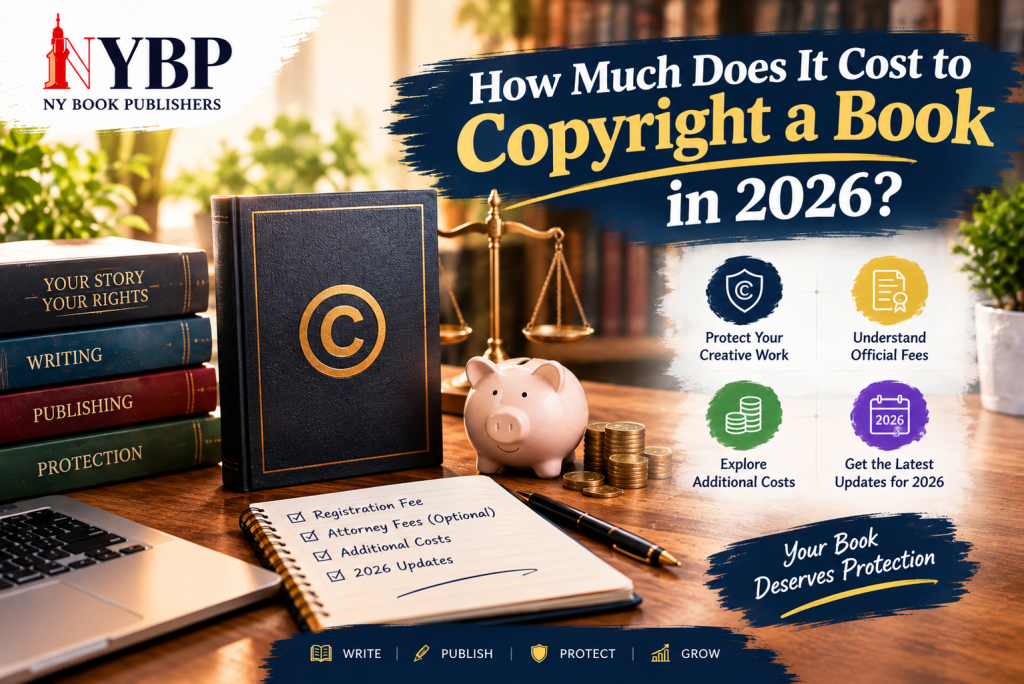
Most authors are surprised to learn the answer: in the United States, it costs between $35 and $65 to formally register a book copyright with the U.S. Copyright Office in 2026. That is the full cost for most standard registrations completed online. But there is something even more important to understand first. Your book is already protected by copyright the moment you write it. You do not need to register to own copyright. Registration is a separate legal step that strengthens your protection and gives you specific legal advantages if your work is ever infringed.
This guide explains exactly how much does it cost to copyright a book, what the registration process involves, when registration genuinely matters, and what authors often confuse about copyright protection. Whether you are a first-time author or a self-published writer preparing to launch, expert book publish services can support you through every stage of the publishing process, including understanding what legal steps are right for your book.
Does Copyright Exist Automatically, or Do You Need to Register?
Copyright is automatic in the United States and in most countries that are signatories to the Berne Convention, which includes over 180 countries worldwide.
The moment you write an original work and fix it in a tangible form, meaning the moment words are on paper or saved in a digital file, copyright exists. You own it. No registration is required. No fee is required. No notice, no symbol, no government form.
So why do so many authors ask how to copyright a book and how much it costs? Because formal registration with the U.S. Copyright Office creates legal advantages that automatic copyright alone does not provide. Understanding the difference between these two things is the most important piece of knowledge any author can have about copyright.
What Automatic Copyright Protects
Automatic copyright gives you the exclusive right to:
- Reproduce your work
- Distribute copies of your work
- Create derivative works based on your work
- Publicly display or perform your work
- License your work to others
These rights exist from the moment of creation and last for the duration of your life plus 70 years for works created after January 1, 1978 under U.S. copyright law.
You do not need to include the symbol on your book for copyright to exist, though including it is good practice because it notifies readers and publishers that you are asserting your rights.
What Formal Registration Adds
Formal registration with the U.S. Copyright Office does not create copyright. It creates a public legal record of your copyright claim and provides several specific legal advantages that matter significantly if your work is ever copied without permission.
- The right to sue for statutory damages. This is the most important practical benefit. If you register before infringement occurs or within three months of first publication, you can sue for statutory damages of $750 to $30,000 per infringement, or up to $150,000 for willful infringement, without needing to prove your actual financial losses. Without registration, you can still sue, but you can only recover actual damages, which are often very difficult to calculate and prove.
- The right to recover attorney’s fees. If you registered before infringement occurred or within three months of publication, you may be able to recover your attorney’s fees if you win a lawsuit. Copyright litigation is expensive. The ability to recover fees is often what makes pursuing a case financially viable.
- A public record of your ownership. Registration creates a public document that establishes when you registered and what you claimed ownership of. This can be valuable evidence in a dispute about who owns a work.
- The ability to record with U.S. Customs. Registered copyright holders can record their registration with U.S. Customs and Border Protection to help stop the importation of infringing copies.
How Much Does It Cost to Copyright a Book in the USA?
Here are the current U.S. Copyright Office fees for 2026:
| Registration Type | Fee |
| Single work by one author (online) | $35 |
| Standard online registration (most works) | $65 |
| Paper application (Form CO) | $125 |
| Group registration of unpublished works (up to 10) | $85 |
| Group registration of published works (serials) | Varies |
| Registration of a claim in a literary work (paper) | $125 |
The $35 fee applies specifically to online registration of a single work by a single author who is also the sole claimant. This covers the vast majority of individual authors registering their own novels, memoirs, or nonfiction books.
The $65 fee covers most other standard online registrations, including works with multiple authors or more complex ownership arrangements.
Paper applications cost $125 because processing paper requires significantly more manual handling. There is no legal advantage to filing on paper. Filing online is faster, cheaper, and produces the same legal outcome.
Important note: These fees are set by the U.S. Copyright Office and are subject to change. Always verify the current fee schedule at copyright.gov before filing.
How Much Does It Cost to Copyright a Comic Book?
How much does it cost to copyright a comic book follows the same fee structure as any other literary or artistic work. A comic book is typically registered as a work that combines text and visual art.
For a single issue created by one author-artist, the $35 online single-author registration may apply. For a comic with separate writer and artist credits or multiple contributors, the standard $65 online registration is more appropriate.
If you are registering a series of issues, group registration options may reduce the per-issue cost. The U.S. Copyright Office’s group registration for serial publications covers periodicals published at regular intervals, which may apply to ongoing comic series.
The copyright in the text and the copyright in the visual artwork within a comic book are separate rights, but a single registration can cover both elements of a single published issue.
How to Copyright a Book: The Step-by-Step Process
Here is how to register a copyright with the U.S. Copyright Office in 2026.
Step 1: Go to the official U.S. Copyright Office website
Visit copyright.gov. The online registration system is called eCO (Electronic Copyright Office). Do not use any third-party services that charge additional fees to file on your behalf when the process is straightforward enough to complete yourself.
Step 2: Create an account
Create a free account on the eCO portal. This account stores your registration history and allows you to track the status of pending applications.
Step 3: Start a new claim
Select “Register a New Claim” and choose the type of work you are registering. For most books, this will be “Literary Work.”
Step 4: Complete the application form
The online form asks for:
- The title of the work
- The year of creation and year of first publication (if published)
- Author information including name and nationality
- Claimant information (who owns the copyright)
- Whether the work is a new work or a revision of an existing work
- Deposit copy information
Step 5: Pay the fee
Pay the applicable registration fee by credit card, debit card, ACH transfer, or copyright office deposit account. The fee is non-refundable even if the registration is not approved.
Step 6: Upload your deposit copy
You must submit a deposit copy of the work, which is a copy of the work being registered. For most literary works, this is a digital file uploaded through the eCO portal. Acceptable formats include PDF, Word documents, and plain text files.
For published books, specific deposit requirements apply, including mandatory deposit with the Library of Congress, which is a separate requirement from registration. Published works may need to submit physical copies to the Library of Congress in addition to digital copies to the Copyright Office.
Step 7: Receive your registration certificate
The U.S. Copyright Office processes online applications and issues registration certificates. Processing times for online applications typically run several months to over a year depending on the current workload at the Copyright Office. However, your legal protection from the registered date begins from the date your completed application, fee, and deposit are received, not from the date the certificate is issued.
How Long Does Copyright Registration Take?
Processing times at the U.S. Copyright Office vary significantly. As of recent years, online applications for literary works have been taking approximately six months to two years to process to completion, with the issuance of a registration certificate.
This does not mean your protection starts when the certificate arrives. Your registration is effective as of the date the Copyright Office receives your complete application. If someone infringes after that date, your legal rights as a registered copyright holder apply even if you have not yet received your certificate.
If you need a registration cerwtificate quickly for litigation purposes, the Copyright Office offers a special handling service for a significantly higher fee (currently $800) that processes registration within five business days.
Do You Need to Copyright Your Book Before Publishing?
You do not need to register before publishing. Copyright exists automatically from creation, so you are already protected when your book is published.
However, if you register before publication or within three months of first publication, you preserve the right to sue for statutory damages and attorney’s fees for any infringement that occurs after publication. This is the most legally protective timing for registration.
If you register after the three-month window following first publication but before any infringement occurs, you can still sue for statutory damages on infringements that occur after your registration date. You would not be able to recover statutory damages for infringement that happened before you registered.
If you only register after an infringement has already occurred, you can still sue, but you can only recover actual damages rather than the more powerful statutory damage amounts.
The practical advice for most authors: register your copyright before or shortly after publication. The cost is modest and the legal protection it adds is substantial.
Does Copyright Registration Work the Same for Self-Published Authors?
Yes. The U.S. Copyright Office treats self-published and traditionally published authors identically for registration purposes.
How much does it cost to copyright a self-published book? The same $35 to $65 online registration fee applies regardless of your publishing method.
The only difference for self-published authors is that the mandatory deposit requirement for published books falls on you rather than on a publisher. When your book is published, you are required by law to deposit two copies with the Library of Congress. This mandatory deposit is separate from registration and does not by itself create a copyright registration.
Many self-published authors complete both registration and deposit simultaneously through the eCO portal, which simplifies the process.
Does an ISBN Protect My Copyright?
No. An ISBN (International Standard Book Number) is a retail identifier used by bookshops, libraries, and distributors to track and order books. It has no legal connection to copyright protection whatsoever.
An ISBN identifies your book in the marketplace. Copyright law protects the content of your book from unauthorized copying. They serve entirely different purposes and neither one substitutes for the other.
Can You Copyright an Unpublished Manuscript?
Yes. Unpublished works are fully eligible for copyright registration and have been since the Copyright Act of 1976.
Registering an unpublished manuscript before you submit it to agents or publishers is a choice some authors make for peace of mind. If your manuscript is registered before any infringement occurs, you have the full statutory damage protection in place.
The U.S. Copyright Office offers group registration for unpublished works, which allows you to register up to 10 unpublished works in a single application for a single fee of $85. For authors who have written multiple manuscripts, this can be a cost-effective option.
Copyright Registration Outside the United States
For authors outside the United States, the registration process and costs differ by country.
- United Kingdom: The UK does not have a formal copyright registration system. Copyright is automatic under the Copyright, Designs and Patents Act 1988 and no registration exists. UK authors can create dated evidence of their copyright through solicitor deposits, dated email records, or services like the UK Copyright Service, but these are evidence tools, not registration systems.
- Canada: Canada similarly has no government copyright registration system. Copyright is automatic under the Copyright Act of Canada.
- Australia: Australia has no copyright registration system. Automatic protection applies under the Copyright Act 1968.
- European Union: Most EU member states do not have formal copyright registration systems. Automatic protection applies across EU countries under the Berne Convention framework.
For UK and international authors, the practical approach to protecting copyright is maintaining careful records of creation dates, version histories, and any communications relating to the work.
What Copyright Does Not Protect
Understanding what copyright does not protect is as important as understanding what it does.
- Ideas are not protected by copyright. Copyright protects the specific expression of an idea, not the idea itself. The concept of a dystopian society is not copyrightable. A specific novel’s particular expression of that concept is.
- Titles are not protected by copyright. Book titles cannot be copyrighted. Multiple books can share the same title legally. Trademark law, not copyright law, offers some protection for distinctive titles used as brand identifiers, but this is a different legal framework with different requirements.
- Facts and data are not protected. Copyright does not protect facts, historical events, or data, only the particular creative expression of them.
- Short phrases and slogans typically cannot be copyrighted, though they may qualify for trademark protection in some circumstances.
Key Takeaways
- Copyright is automatic from the moment you write your book. No registration required for basic protection.
- Formal registration with the U.S. Copyright Office costs $35 to $65 online for most authors in 2026.
- Registration unlocks the right to sue for statutory damages ($750 to $150,000 per infringement) and attorney’s fees.
- Register before publication or within three months of first publication to preserve maximum legal protection.
- Paper applications cost $125. There is no legal benefit to filing on paper over filing online.
- ISBNs have no connection to copyright protection.
- UK, Canadian, and Australian copyright is automatic. No registration system exists in these countries.
- Copyright protects expression, not ideas, titles, facts, or short phrases.
Let NY Book Publishers Help You Publish With Confidence
Understanding copyright is one piece of the publishing puzzle. Getting your book to readers professionally is the next step. Once your manuscript is ready, book publishing companies in New York like NY Book Publishers offer comprehensive publishing support that covers everything from editing and design to distribution and marketing strategy. For authors ready to take their book to the next level, exploring resources like how to promote a book in 2026 gives you a practical roadmap for building the readership your book deserves.
Frequently Asked Questions
How much does it cost to copyright a book in 2026?
In the United States, online registration with the U.S. Copyright Office costs $35 for a single work by a single author or $65 for most other standard online registrations. Paper applications cost $125. These fees are paid directly to the U.S. Copyright Office at copyright.gov. Note that your book is already protected by copyright automatically the moment you write it. Registration adds legal advantages but does not create the underlying copyright.
What is the cheapest way to copyright a book?
The cheapest formal registration is the $35 online single-author registration through the U.S. Copyright Office’s eCO portal at copyright.gov. This applies to a single literary work where one author is both the creator and the sole copyright claimant. Filing online is always cheaper than filing on paper and produces the same legal outcome. If you have multiple unpublished manuscripts, the group registration option at $85 for up to 10 works may offer the best per-work value.
Do I need to register my book with the U.S. Copyright Office?
No, registration is not required for copyright to exist. Your book is protected automatically from the moment you write it. However, registration is strongly recommended before or shortly after publication because it gives you the right to sue for statutory damages (up to $150,000 per willful infringement) and to recover attorney’s fees, rights that are not available without registration.
Does an ISBN protect my book’s copyright?
No. An ISBN is a retail identification number used by bookshops and distributors to track books. It has no legal connection to copyright protection. Copyright and ISBN serve entirely different purposes. An ISBN identifies your book in commerce. Copyright law protects the content of your book from unauthorized copying.
How much does it cost to copyright a self-published book?
The same fees apply to all authors regardless of publishing method. Online registration costs $35 to $65 for most self-published books through the U.S. Copyright Office. Self-published authors also have the same mandatory deposit obligation with the Library of Congress as traditionally published authors once their book is published.
Do I need to copyright my book before publishing it?
No, but registering before publication or within three months of first publication is the most legally protective approach. If you register within that window, any infringement that occurs after publication will be subject to statutory damages and attorney’s fee recovery. If you register after the three-month window, you lose statutory damage rights for infringement that occurred before your registration date.
How long does it take to copyright a book?
The U.S. Copyright Office processes online applications in approximately six months to two years depending on current workloads. However, your legal registration is effective from the date the Copyright Office receives your complete application and payment, not from when the certificate is issued. If you need a certificate quickly for legal proceedings, a special handling service is available for $800 and processes within five business days.
Can I copyright an unpublished book manuscript?
Yes. Unpublished works are fully eligible for copyright registration in the United States. You can register your manuscript before submitting to agents or publishers if you want a formal registration record in place. The U.S. Copyright Office also offers group registration for up to 10 unpublished works at $85, which can be cost-effective for authors with multiple unregistered manuscripts.